
ENTERPRISE-GRADE — IP GATEWAY — AD INSERTER — IP DISTRIBUTION — DAB/DAB+ READY
EMS IP MOZART is a cloud-managed broadcast distribution and regional advertisement insertion platform for television networks, radio broadcasters, OTT operators, IPTV providers and DVB-T/T2, DAB and DAB+ infrastructures. Secure SRT/RIST delivery over the public internet · independent city IP distribution management · managed edge nodes · multi-tenant RBAC · REST API.
A unified cloud broadcast operating platform.
Enterprise-grade capabilities adapted from EMS Ad Inserter and extended for managed cloud, hybrid edge, IP gateway and DAB/DAB+ radio workflows.
From national feed to every regional screen and radio service.
Six cloud-managed pipeline stages from broadcaster ingest through secure IP gateway distribution, regional ad insertion and final delivery to DVB-T/T2, DAB/DAB+, IPTV and OTT.
One cloud console. Every workflow.
The same high-quality EMS operating surfaces, tuned for managed cloud and hybrid broadcast teams.
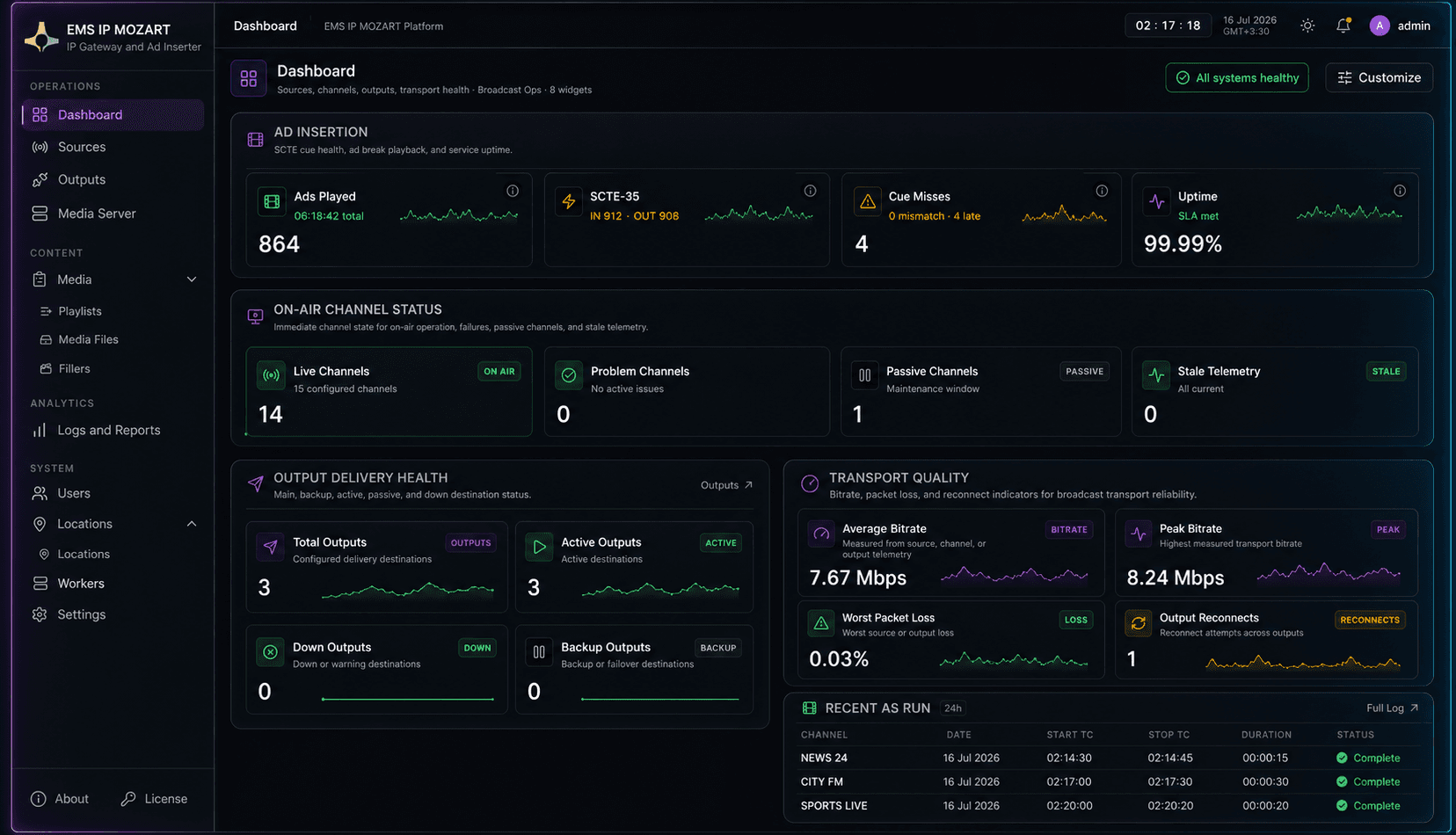
Real-time visibility across every channel, region, edge workflow and stream.
Cloud-managed. Edge-capable. Broadcast-grade.
Built for managed cloud and hybrid deployments using containerised services, resilient storage, stream monitoring and a full REST API for ecosystem integration.
Frame-accurate cloud ad insertion built for live broadcast.
The EMS SCTE-35 engine delivers GOP-aware switching at IDR frame boundaries with stream compatibility checks before each insertion. Dynamic ad replacement supports live schedule updates through the REST API, and filler protection keeps configured outputs clean when an asset is unavailable.
- GOP-aware switching at IDR / I-frame boundaries
- Splice Insert · Time Signal · Splice Null · Break Duration
- Automatic filler extension when ad assets are unavailable
- Real-time SCTE-35 event logging with export for compliance and billing
One cloud platform for DVB-T/T2, DAB/DAB+, IPTV, OTT, FAST and radio.
EMS Ad Inserter Cloud distributes national feeds to broadcast, streaming and radio outputs while applying localised ad insertion independently for every city, region or channel group.
- DVB-T / DVB-T2 UDP output to modulator or head-end mux
- DAB and DAB+ radio distribution workflows
- IPTV middleware via UDP Multicast or SRT
- OTT: HLS, RTMP and SRT encoder output
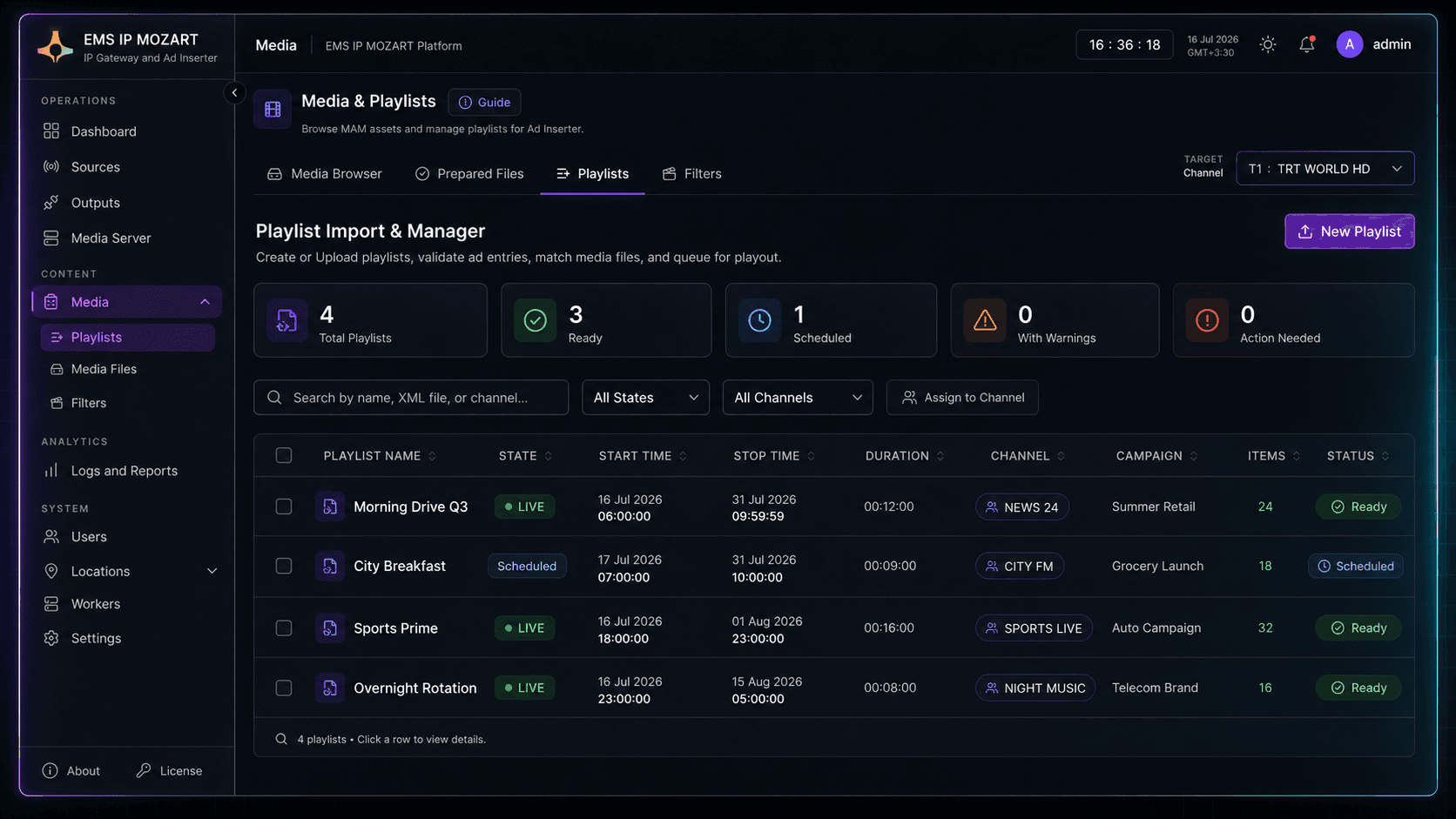
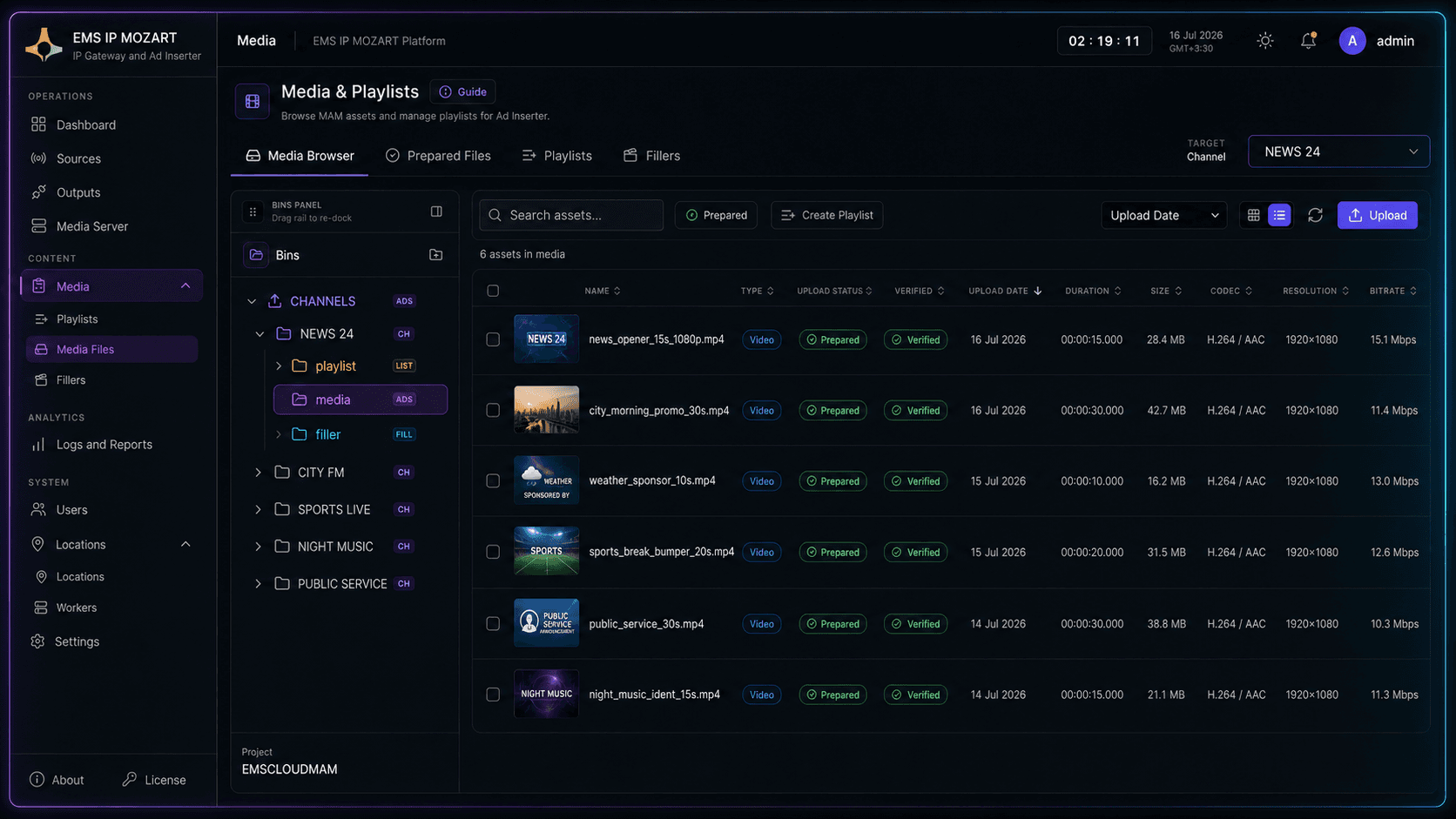
Media asset management for cloud ad operations.
A unified media library manages advertisement, filler and campaign assets across the platform with resumable upload, automatic validation, transcoding and distribution to assigned cloud or edge workflows.
- Central media library with channel and region organisation
- Chunked resumable upload · CSV, JSON and XML playlist import
- Automatic format validation, transcoding and compliance checks
- Local cache sync to edge workflows with retention policy controls
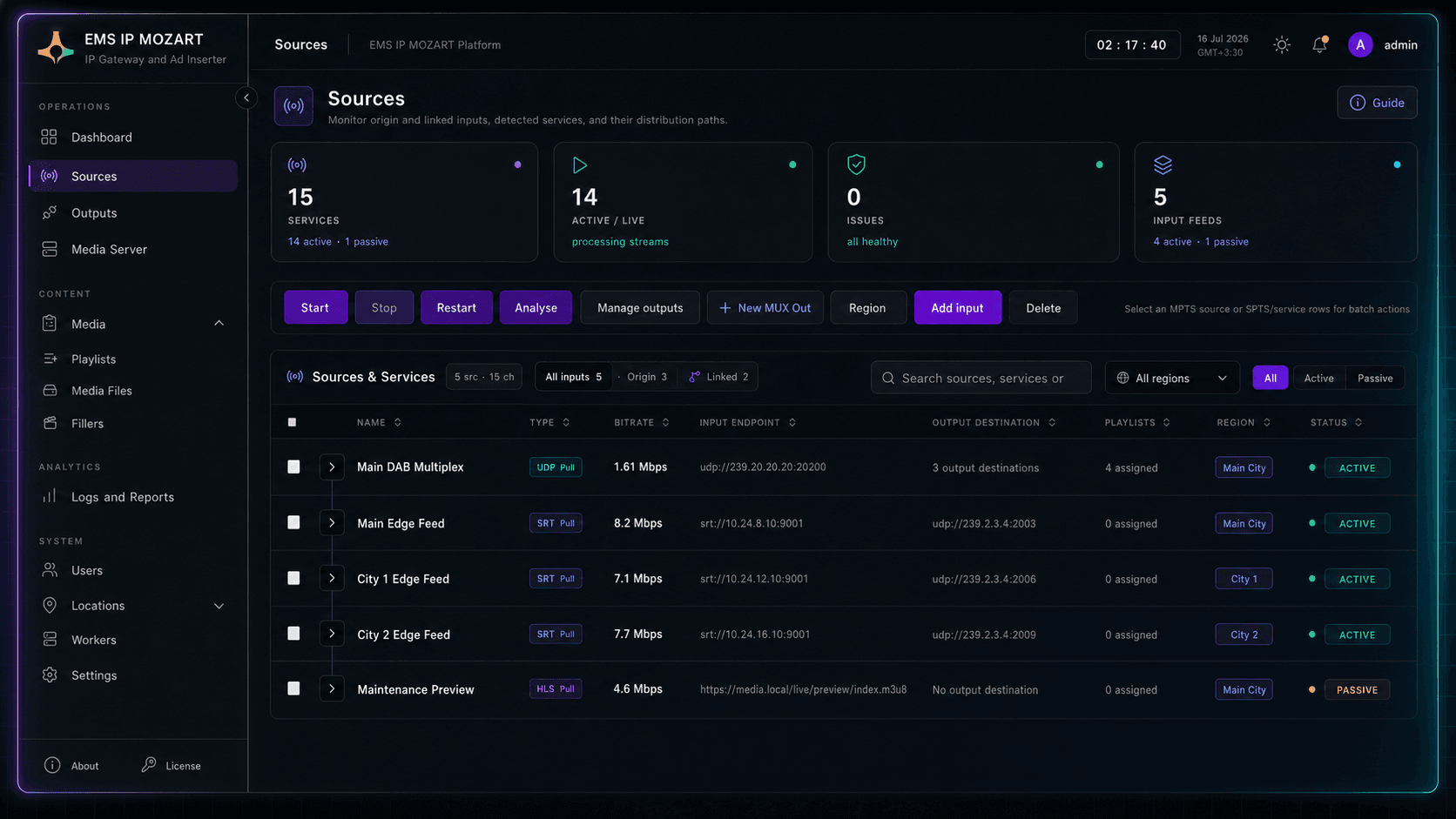
Monitor every incoming service and regional feed.
The Sources workspace brings DAB multiplexes, SRT edge feeds, HLS previews and linked distribution paths into one operational view with live health and regional status.
- DAB multiplex, SRT and HLS input visibility
- Active, passive and issue state monitoring
- Region-aware source and service management
- Direct mapping from input endpoint to output destination
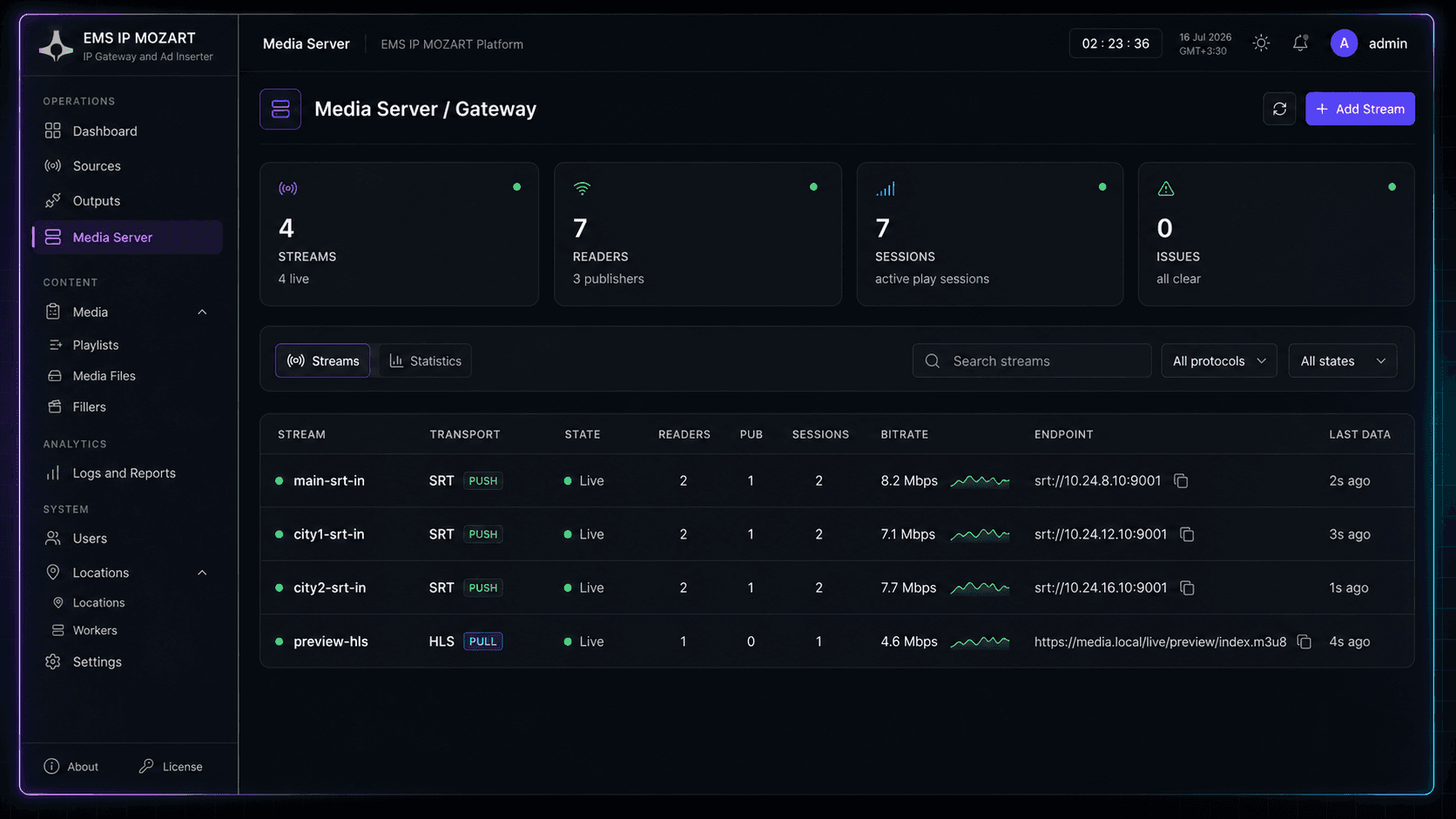
Control live gateway streams and play sessions.
Operate SRT and HLS streams from the Media Server/Gateway console with live reader, publisher, session, bitrate and endpoint visibility.
- SRT push and HLS pull stream management
- Live readers, publishers and session counts
- Per-stream bitrate and endpoint monitoring
- Immediate issue status for gateway operations
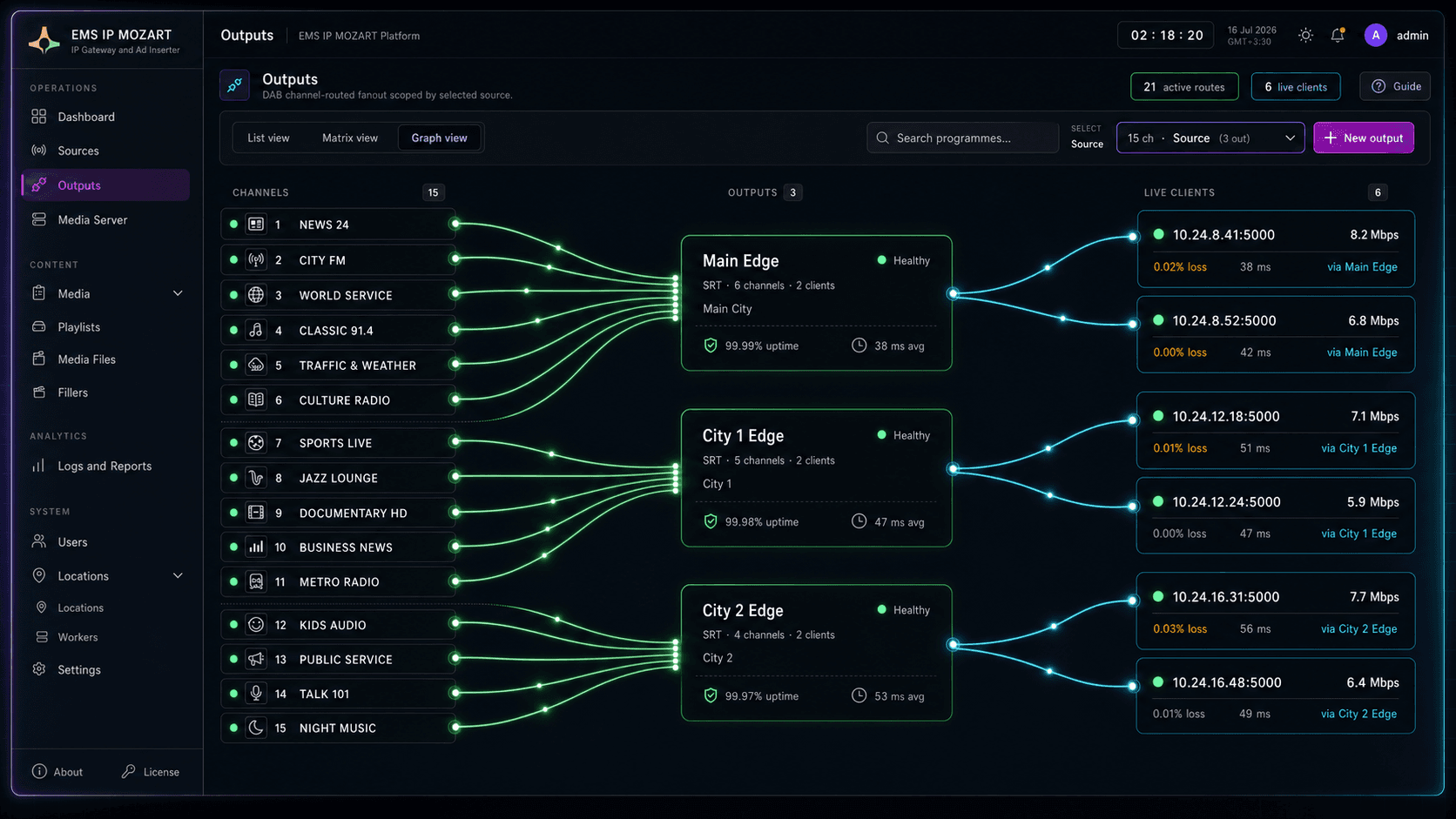
Visualise channel fanout to every city edge and live client.
The graph view shows how TV and radio channels route through healthy SRT edge gateways to live clients, with bitrate, packet-loss, latency and uptime context.
- DAB and TV channel routing in one graph
- Independent city edge distribution paths
- Live client bitrate, latency and packet-loss telemetry
- Health and uptime visibility across every route
Run in the cloud. Extend to the edge.
EMS Ad Inserter Cloud gives broadcasters central cloud control with secure IP gateway distribution and optional local edge execution for latency, resilience and regulatory requirements.
Built for enterprise operations.
AES-256 · TLS 1.3 · RBAC · Audit logging · Managed containers.
Traditional appliances vs. EMS Ad Inserter Cloud.
Cloud-managed broadcast operations reduce deployment friction while preserving carrier-grade control.
| Capability | Traditional stack | EMS Cloud |
|---|---|---|
| Infrastructure | Proprietary hardware appliances in every site | Managed cloud services with optional edge workflows |
| IP gateway | Separate gateway devices and manual routing | Integrated secure IP gateway distribution |
| Radio support | Separate workflows for digital radio | FM, DAB and DAB+ workflows in the same platform |
| Scaling | Capacity added by installing more hardware | Scale cloud workflows and edge services as demand grows |
| Maintenance | Complex appliance updates and spare parts | Managed updates and container-based operations |
| Redundancy | Site-by-site failover design | Cloud plus edge redundancy with central monitoring |
| Operations | Fragmented tools across TV, OTT and radio | Unified cloud console for converged delivery |
| Integrations | Static, vendor-specific workflows | API-driven architecture for traffic, monitoring and reporting |
Cloud economics for regional broadcast monetisation.
EMS Ad Inserter Cloud creates regional ad revenue opportunities without making every expansion a hardware project.
Built for every cloud-ready operator in the broadcast chain.
From national TV networks and multiplex operators to IPTV providers, OTT/FAST operators, DAB/DAB+ radio broadcasters and government broadcast authorities.
Ready to move ad insertion and IP gateway workflows to the cloud?
Book a live working session with our solutions architects. We will map your TV, OTT, IPTV, DAB/DAB+ and regional ad workflows into a practical cloud or hybrid deployment plan.